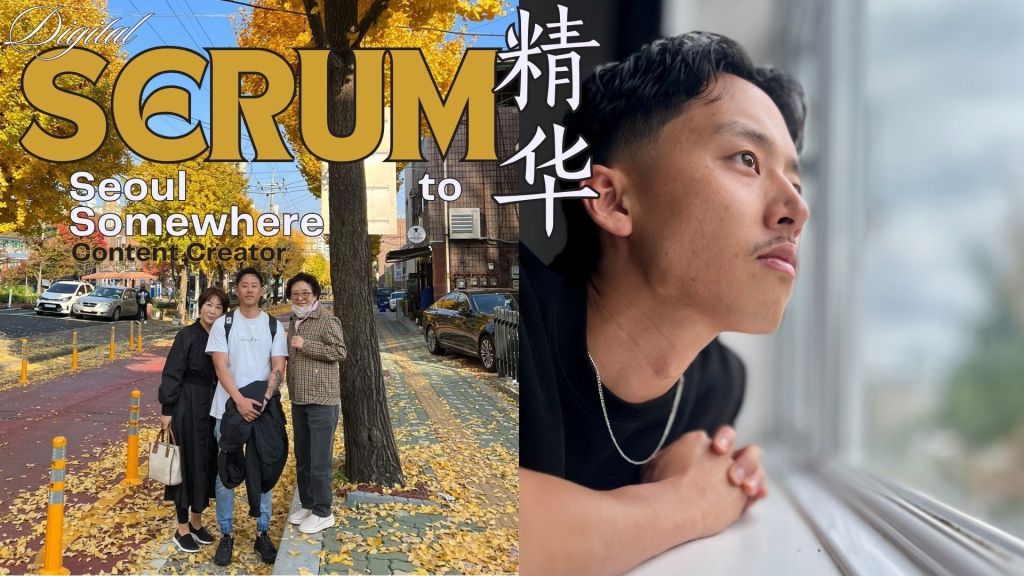
In an era defined by mobility, migration, and hybrid identities, the question of where we belong has become less about geography and more about meaning.
For Nathan — a Korean-born New Zealander raised in Christchurch — the search for home has become both a personal journey and a public conversation.
His platform, Seoul to Somewhere, is intentionally unpolished. No heavy editing. No curated narrative. Just a camera, a voice, and a stream of thoughts shared as they come.
“I wanted it to be genuine,” he explains. “If people want to connect with it, they’ll find it. It was a way to vent — to say what I was thinking without feeling like I was burdening the people around me.”
The response has been immediate and deeply personal. Viewers across the diaspora — migrants, children of immigrants, third culture adults — have recognised themselves in the tension he describes: living between cultures, between expectations, between versions of home.
Leaving to understand
In 2025, Nathan and his partner packed their lives into suitcases and left New Zealand. London became their base — not as an escape, but as an experiment in belonging.
Online, some questioned the decision. Why leave for a city perceived as less diverse than Aotearoa?
The reality, he says, surprised him.
“When I landed, it was the most diverse place I’ve ever seen in my life. Everywhere you turn, there’s a different culture, a different community. That feeling — I’ve been loving that.”
For Nathan, the move wasn’t about rejecting New Zealand. In fact, he speaks about Christchurch with affection — a place of strong memories and formative experiences.
But like many migrants raised in predominantly Western environments, he also carries the quieter memories: moments of exclusion, casual racism, and the long-standing pressure to assimilate.
“At one point, I was trying to be fully Western. I didn’t want to stand out. I even pushed my own culture away so I could fit in.”
That internal negotiation — between heritage and acceptance — is a familiar story for many immigrants who came of age in the 1990s and early 2000s.
Belonging without borders
Nathan is careful not to frame his story as a rejection of New Zealand. If asked where home is, his answer remains clear.
“New Zealand is home. One hundred percent.”
But the journey he is documenting reflects a broader shift in how home is understood.
For many globally mobile individuals, home is no longer singular. It may be physical in one place, emotional in another, and cultural somewhere else entirely.
That idea is reinforced by his experience in London — a city where diversity itself becomes a form of belonging.
“For the first time, I feel like I can just exist without having to explain who I am.”
Living the question
If there is a defining feature of Nathan’s journey, it is uncertainty.
He is not documenting a transformation or a resolution. He is documenting the process — moving, observing, questioning, and only later making sense of what it all means.
“Right now, I’m just experiencing it,” he says. “I’ll unpack it later.”
For a generation raised between cultures and connected across continents, that approach may be the most honest one available.
Home, after all, may no longer be a destination.
It may be something you build — slowly — between worlds.
 SERUM 精华 Online news for the creative diaspora.
Leave a comment